Posts Subscribe comment Comments

Earn Money With Your Website

Saturday, November 5, 2005

The Last Word On Nigerian Internet Scam

The on-going developments to eradicate the notorious Nigerian Internet Scams are appreciated. I have also drummed the warning into the ears of the ignorant millions of fall-guys in the Western world, Asia and Australia who are the primary target of the ruthless Internet scammers. And this latest news will be my final report on the matter. No more, no less. Only morons would be conned. Because, they are either criminals themselves or they are fools.Finis.

British and Nigerian officials are teaming up to warn Internet users of fraudulent e-mails that try to con recipients into handing over cash.

The so-called Nigerian 419 scams have been a problem for a number of years; the partnership issued a statement Friday warning people about e-mails that "ask for help in moving large sums of money in exchange for a share of the spoils."

Christine Wade, director of consumer regulation enforcement for the U.K. Office of Fair Trading, said in a statement:

"If you are targeted, recognize the 419 for what it is--an attempt to defraud you. Do not reply and do not give your personal details out. You are not about to become rich. These scams bear the hallmarks of professional criminals--use your common sense and don't become their next victim."


The scams were named "419ers" after the relevant section of the Nigerian criminal code. Many, but not all, originate from Nigeria and other West African nations.

Last month, Microsoft announced a partnership with the Nigerian government to help track down and prosecute criminals involved in the scams and other Internet-based fraud originating there.

Nuhu Ribadu, the executive chairman of the Economic and Financial Crimes Commission of Nigeria, said in a statement that "419 and other Nigerian variants of cybercrime have done unquantifiable damage to Nigeria's image and credibility. The government has resolved to deal a fatal blow to the cybercrime networks operating from Nigeria and the West African sub-region."

The commission said it will be monitor cybercafes and take on a "significant" number of cases against such criminals based in Nigeria.

Nigeria has agreed to work with the other 26 member countries involved in the antispam effort known as the London Action Plan.

Friday, November 4, 2005

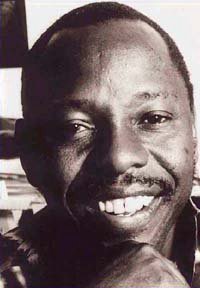
Ken Saro-Wiwa: Not Yet Uhuru

Kenule Beeson Saro-Wiwa (October 10, 1941 - November 10, 1995)

Activities to mark the 10 years anniversary of the extra-judicial execution of Ken Saro-Wiwa and the other eight leaders of MOSOP started months ago in over 30 countries and will climax next week Thursady November 10, in Port Harcourt the capital of Rivers State with the launching of a commemorative magazine, titled:"If I Live To Tell The Tale,Ken Saro-Wiwa:Ten Years Later" at the Banquet Hall of the Hotel Presidential in Port Harcourt. Many literary dignitaries and hundreds of other personalities are already arriving from other countries for the memorial events.
There will also be other important and significant events such as the formal launching of the Ken Saro-Wiwa Foundation (KSWF)in Nigeria.

As much I appreciate all the laudable and remarkable efforts to remember the supreme sacrifice of Ken Saro-Wiwa the martyred champion of human rights in the Niger Delta region of Nigeria,please remember also the other martyrs who have been murdered before and after the hanging of Ken Saro-Wiwa and his fellow comrades. Let us not forget Bawo Ajeboghuku,who died of gunshot wounds and over 17 others killed by members of the bloody task force of demons in military uniform armed by the draconian government of President Olusegun obasanjo during a raid on Odioma town in Bayelsa state in February.The forces razed "80 percent of the homes in Odioma and the dead included 105-year-old woman Balasanyun Omieh and her two-year-old grandchild, according to to an Amnesty Report.

They are all martyrs and they are equally as important as Ken Saro-Wiwa to the collective history and destiny of the Niger Delta. So, the Niger Delta struggle is not the monopoly of the Ken Saro-Wiwa family or the Ogoni people, but the struggle for the survival and wellbeing of the people of the Niger Delta region of Nigeria.

Ken,it is not yet Uhuru.Because, the demons of tyranny are still on rampage in the creeks and villages of Niger Delta. And I pray that we shall not resort to the tactics of the Mau-Mau to defeat the oppressors and violators of our precious lives.

The biography of Ken Saro-Wiwa is from Wikipedia, the free encyclopedia.

Ken Saro-Wiwa was a successful businessman, novelist, television producer and political activist in Nigeria.Kenule Beeson Saro-Wiwa (October 10, 1941 - November 10, 1995) was a Nigerian author, television producer and environmental activist.

Ken Saro-Wiwa was a member of the Ogoni, an ethnic minority whose homelands in the Niger Delta have been targeted for oil extraction since the 1950s. As president of the Movement for the Survival of the Ogoni People (MOSOP), Saro-Wiwa led a nonviolent campaign against environmental damage associated with the operations of multinational oil companies, including Shell and British Petroleum.

Saro-Wiwa was also a successful businessman, novelist and television producer. His best known novel, Sozaboy: A Novel in Rotten English, tells the story of naive village boy recruited to the army during the Nigerian civil war (1967-1970). His war diaries, On a Darkling Plain, document Saro-Wiwa's experience during the war, when he served as the Civilian Administrator for the port of Bonny in the Niger Delta. His satirical television series, Basi & Co., is purported to have been the most watched soap opera in Africa.

In the early 1970s, Saro-Wiwa served as the Regional Commissioner for Education in the Rivers State Cabinet, but was dismissed in 1973 because of his support for Ogoni autonomy. In the late 1970s, he established a number of successful business ventures in retail and real-estate, and during the 1980s was able to concentrate on his writing, journalism and television production.

In 1990, Saro-Wiwa founded MOSOP, to advocate for the rights of the Ogoni people. The Ogoni Bill of Rights, written by MOSOP, set out the movement's demands, including increased autonomy for the Ogoni people, a fair share of the proceeds of oil extraction, and remediation of environmental damage to Ogoni lands. In 1992, Saro-Wiwa was imprisoned for several months, without trial, by the Nigerian military government.

In January 1993, MOSOP organised peaceful marches of around 300,000 Ogoni people - more than half of the Ogoni population - through four Ogoni centres, drawing international attention to his people's plight. The same year, Shell ceased operations in the Ogoni region.

Saro-Wiwa was arrested again and detained by Nigerian authorities in June 1993, but was released after a month. In May 1994, he was arrested and accused of incitement to murder following the deaths of four Ogoni elders, believed to be sympathetic to the military. Saro-Wiwa denied the charges, but was imprisoned for over a year before being found guilty and sentenced to death by a specially convened tribunal. The trial was widely criticised by human rights organisations.

On November 10, 1995, Saro-Wiwa and eight other MOSOP leaders were executed (hanged) by the Nigerian military government of General Sani Abacha, provoking the immediate suspension of Nigeria from the Commonwealth of Nations, which was meeting in New Zealand at the time.

A biography, In the Shadow of a Saint, was written by his son, journalist Ken Wiwa. Ken Saro-Wiwa's daugher Zina Saro-Wiwa is a filmmaker and arts journalist.


Statement made by Saro-Wiwa just before his execution:
"I repeat that we all stand before history. I and my colleagues are not the only ones on trial. Shell is on trial here, and it is as well that it is represented by counsel said to be holding a watching brief. The company has, indeed, ducked this particular trial, but its day will surely come and the lessons learned here may prove useful to it, for there is no doubt in my mind that the ecological war the company has waged in the delta will be called to question sooner than later and the crimes of that war be duly punished. The crime of the company's dirty wars against the Ogoni people will also be punished.

On trial also is the Nigerian nation, its present rulers and all those who assist them. I am not one of those who shy away from protesting injustice and oppression, arguing that they are expected of a military regime. The military do not act alone. They are supported by a gaggle of politicians, lawyers, judges, academics and businessmen, all of them hiding under the claim that they are only doing their duty, men and women too afraid to wash their pants of their urine.

We all stand on trial, my lord, for by our actions we have denigrated our country and jeopardised the future of our children. As we subscribe to the subnormal and accept double standards, as we lie and cheat openly, as we protect injustice and oppression, we empty our classrooms, degrade our hospitals, and make ourselves the slaves of those who subscribe to higher standards, who pursue the truth, and honour justice, freedom and hard work."

Thursday, November 3, 2005

Amnesty Protests Against Extra-Judicial Killings In The Niger Delta

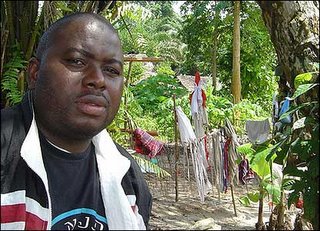
ASARI DOKUBO THE NIGER DELTA REVOLUTIONARY HUMAN RIGHTS ACTIVIST IS CURRENTLY IN DETENTION IN NIGERIA.

Amnesty has called on the Nigerian government to stop extra-judicial killings in the Niger Delta of Nigeria.

"We haven't seen any extra-judicial executions since...1995 but in terms of other human rights violations the problems are still there," said Ulrika Sandberg, one of the authors of the Amnesty report.


If Amnesty says it has not seen extra-judicial executions since 1995 does not mean that there were no judicial executions in Nigeria. What Amnesty should say is that Amnesty is ignorant of any extra-judicial executions. Because, extra-judicial executions of over 1,000 civilians have been reported since 1999 to date. And most of them were done with the full knowledge of the ruling authorities of the present government of Nigeria. Even cases of massacres of innocent Nigerians have been witnessed in the Niger Delta region of Nigeria. And Amnesty has done nothing more than make statements in order to justify it's existence and collect more funds to continue it's work as the toothless watchdog of human rights.

I am not interested in toothless watchdogs that cannot protect the helpless people they are meant to guard.

When Amnesty begins to sue Tyrannical corporations, governments,institutions and the draconian rulers found guilty of the violations of human rights, then I would be convinced that Amnesty is truly active and proactive not only in whistle-blowing, but in the prosecution of crimes against humanity in Nigeria and other parts of the world like in Indonesia where Islamic terrorists have been killing innocent Christians and only recently three Christian girls were beheaded by Islamic terrorists in Indonesia. And what is Amnesty doing about it?

Read the news report below.

Nigeria must end army killings in oil delta-Amnesty
03 Nov 2005 00:01:10 GMTSource: Reuters
By Estelle Shirbon

ABUJA, Nov 3 (Reuters) - Nigerian security forces protecting oil industry interests in the southern Niger Delta kill local people and raze villages with impunity, human rights group Amnesty International said in a report published on Thursday.
Amnesty accused the government of ignoring the army's abuses and failing to tackle the poverty and injustice it said were the root causes of frequent unrest in the delta.

Nigeria is the world's eighth oil exporter and the bulk of its 2.4 million barrels per day output comes from the delta.
"Despite a return to civilian government in 1999, those responsible for human rights violations under military governments have not been brought to justice," Amnesty said.
"The security forces are still allowed to kill people and raze communities with impunity," it added.

It called on the government to set up independent inquiries into abuses in the area, including a raid by security forces in February on the village of Odioma. It said at least 17 villagers were burnt or shot to death in the raid, two women were raped and 80 percent of homes were razed.

The human rights group said foreign oil companies, as partners of the Nigerian state in exploiting the delta's oil resources, bore a share of responsibility for the poor human rights situation in the region and should do more to improve it.
Most of the 20 million people in the delta, a maze of swamps and mangrove creeks, live in poverty with no basic services.

Many resent the oil industry which, as they see it, has wrecked their environment and generated enormous profits from their lands, but yielded few benefits for them.
This sense of injustice breeds frequent protests at oil facilities as well as sabotage, theft of crude, kidnappings of oil workers and conflicts between communities.

VILLAGE RAID
The report highlights the Odioma raid and another incident in February in which soldiers fired on protesters at an oil terminal operated by Chevron , killing one and injuring at least 30 others, according to Amnesty.

The protesters had entered the facility to show their anger at what they saw as unfulfilled promises from Chevron of jobs and development for their community.
Amnesty said these examples demonstrated that the human rights situation in the delta has not improved in the 10 years since environmental and human rights activist Ken Saro-Wiwa and eight others were hanged by the government.

The hangings in November 1995, under military dictator Sani Abacha, caused an international outcry and Nigeria became a pariah state. In 1999, a civilian government took power after 15 years of army rule and Nigeria, Africa's most populous country, has since regained respectability.

"We haven't seen any extra-judicial executions since...1995 but in terms of other human rights violations the problems are still there," said Ulrika Sandberg, one of the authors of the Amnesty report.
"We're aware of a few initiatives by the government and by companies to address the human rights situation but we've seen very few effects on the ground," she told Reuters.

Wednesday, November 2, 2005

The Crocodile Tears Of Nigerians


The Crocodile Tears of Nigerians

There was a report that called Nigerians the happiest people in the world. But, that was an erroneous report. Because, the truth is Nigerians are the most hypocritical people in the world who are very good in the Fine Arts of Pretension, Seduction, Self-Gratification and Temptation. And the recent tragedies of the air disaster in Lisa Village in Ogun State of Nigeria and the death of the wife of the President of Nigeria, Mrs. Stella Obasanjo gave Nigerians the classic stage to act their best melodramatic roles in Hypocrisy as they competed in shedding crocodile tears.

In an open Condolence Letter addressed to the President of Nigeria, the conscience of Nigeria, the erudite legal luminary and human rights activist Dr. Gani Fawehinmi has come out with a classification of the different forms of Crocodile Tears in Nigeria as shed by all the fake and real mourners at the funeral services held for the late First Lady of Nigeria, Mrs. Stella Obasanjo and the 117 victims of the Catastrophic Bellview Airlines plane crash. These are the different forms of Crocodile Tears Dr. Gani Fawehinmi identified as follows:
§ Genuine Tears
§ Ministerial Tears
§ Contract Tears
§ Rotten-Head Tears
§ 2007 Tears
§ Teasing Tears
§ Oil Block Tears
§ Ghana Must Go (GMG) Tears
§ Immunity Tears
§ Pardon Me Tears
§ Face-Showing Tears or Notice Me Tears
§ Business Tears
§ Brixton Prison Tears among other forms of Crocodile Tears Nigerians know how best to shed for all occasions.

Gani Fawehinmi said, “Even Stella will chuckle in her grave.”
For more on these Nigerian Crocodile Tears and other issues raised by Gani Fawehinmi in his open letter to the Chief Olusegun Obasanjo, see The Guardian newspaper of Monday, October 31, 2005.

Tuesday, November 1, 2005

Open Letter To The Police Performance Monitoring Unit(PPMU)

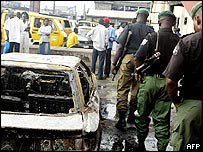
NIGERIAN POLICE OFFICERS AT WORK IN LAGOS

The Coordinator
The Police Performance Monitoring Unit(PPMU)
8th floor
Federal Secretariat Complex
Shehu Shagari Way,
p.m.b.041, Garki,
Abuja.

Dear Sir,

Subject: The Nigerian Police Deserves The Best

I welcome the establishment of the Police Performance Monitoring Unit (PPMU.)
May I advise you that if the PPMU must succeed, we must first and foremost address the primary issue of the abject neglect of the welfare of the Nigerian Police since the 1970s to date.

The police force in Nigeria has suffered untold hardship and injustice by the Federal Government of Nigeria.

The neglect of the Nigerian Police by the government is the cause of the lack of public respect and the loss of public confidence.

The Nigerian police men and women are treated like slaves or prisoners of war as can be seen by the deplorable conditions of the police barracks in Nigeria. I cannot put my worst enemies in those terrible accommodations where I cannot use the toilets and I cannot breathe well. and I avoid going into them or even passing through them. Because I cannot bear the horrible state of the living quarters of the police barracks.

A Nigerian police cell is like a hole in hell.

The Nigerian police office is like an abandoned building.
The Nigerian police men and women are the least paid police officers in the world.
They don’t have enough supplies of uniform and boots. I have seen them wearing canvas shoes and slippers to work in torn and worn black clothes looking like mourners.

Seeing is believing. Go and visit them and ask to use their toilets. You will vomit and faint if you don’t run out of the barracks, lest you risk contracting contagious diseases and other infections.

Sir,
To make your fellow humanbeings to live in such horrible and terrible conditions as the police men and women are doing at present is evil, wicked and an injustice of the worst kind. a criminal act of man’s inhumanity to man.
It is wicked to accuse them of taking bribes when you have not provided for their basic human rights as clearly addressed in the United Nations charter on human rights.

The police officers at the check-points don’t collect bribe.
They only ask the road users to give them money which they often spend on providing for the hungry families and buying medicine to cure or prevent the diseases they contracted from the dirty and filthy environment you have condemned to in the police barracks.

If Nigeria does not have the money to provide for the Nigerian police men and women, I would not have bothered at all. But, Nigeria has all the money to provide for them and the ruling government is not doing so. And that is injustice.
God will judge and punish you all corrupt and wicked oppressors of the poor and needy in Nigeria.

The judgment day is coming!!!

Sir,
Please, address these issues I have stated above, because the Nigerian police deserve the best as you all are enjoying in your cosy luxury houses in Asokoro, Maitama and the exclusive residential areas in Nigeria, because we must treat others as we treat ourselves and not treating them like dogs.

Do you know that the Alsatian dogs of the rich and mighty in Nigeria are better treated than our police men and women. And what they spend in feeding their “Oyinbo” dogs in one week is 100% more than the minimum wage of the police constable in Nigeria.

I am shedding tears in my heart and soul as I am writing this letter.

We cannot continue tolerating these wicked acts of man’s inhumanity to man in Nigeria.

The revolution is coming.
The judgment day is coming.

May the almighty God help you to do your duty in justice, peace and equity.


Respectfully yours,
Orikinla Osinachi.