Posts Subscribe comment Comments

Earn Money With Your Website

Saturday, July 16, 2005

BLOGGERS UNITE IN PHILIPPINE REVOLUTION

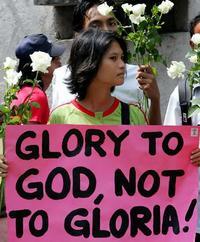
A Protester declares her stand with
fresh flowers and banner in the Philippines.
Bloggers unite

in Philippine revolution

By Connie Levett
Bangkok, July 16, 2005.

Email to a friend


First came the velvet revolution in Czechoslovakia, then the orange revolution in Ukraine. Now the Philippines, fighting public fatigue with the whole political process, is gearing up for the cyber revolution.

For the third time in 20 years, there is a real threat that a Philippine president will be forced from office by public anger.

But unlike previous revolutions waged by million-strong crowds on the broad avenues of Manila, this political crisis is being fought out on the information superhighway, where police are finding it harder to control nimble bloggers.
"U-uuy, somebody's making the rounds of the blog sites leaving the same messages trying to convince people that GMA didn't cheat. pung!" a Filipino blogger warned this week.

GMA is embattled President Gloria Macapagal Arroyo and the cheating refers to allegations that she fixed the vote in last year's presidential election.
This revolution is all about control of information. The election-fixing allegations centre on taped phone calls allegedly between the President and an electoral commissioner, Virgilo Garcilliano. When the allegations surfaced in early June, threats from the Arroyo administration stopped the mainstream media from publishing the contents because the calls had been illegally recorded.

This created an online blog bonanza.
"One of the most influential groups in the blogging community are mainstream journalists putting out their own websites," Roby Alampay, executive director of the South-East Asian Press Alliance, said.

The Philippine Centre for Investigative Journalism was also crucial in the online campaign. The centre first aired the three-hour tape of the conversations, offering it as a download on its website in early June. The site collapsed under the pressure of interest.

"It proved to be the turning point for GMA, the tape being leaked," Mr Alampay said.
The centre appealed to the blogging community and more than a dozen mirror sites were set up to cope with the traffic. The transcript was also popular, downloaded 100,000 times in three weeks.

Not everyone thought the cyber revolution was good for the country. In late June, a computer security whiz was asked to hack the site of the investigative journalism centre. He declined. Unbeknown to the caller, the whiz was a friend of the centre and warned the group.

A week later on June 27, as the President addressed the nation in a carefully scripted half-apology, the centre's website went down, preventing any blog analysis for more than 12 hours - a lifetime in cyber space.

In the weeks since, the diminutive President has been fighting to slow the momentum for her eviction.

She has exiled her controversial husband, offered fuzzy future constitutional change and promised new infrastructure.

But it may be the public's political fatigue, rather than a desperate road-building program, that saves her.

"Here comes the mob, take down a president by force, we start over again, take down another president by force, we start over again, take down a third president by force, we start again," wrote one blogger.

"We will never get anywhere economically if we continue doing this forever. There has got to be a better way to deal with this political problem. Why not try following due process for a change?"

Mr Alampay said people were genuinely fatigued with the people-power phenomenon and the fact they had been bitterly disappointed every time people power succeeded.

Sheila Coronel, head of the investigative journalism centre, believes the President is trying to outlast her detractors.

That settlement is still far from clear. The opposition smell blood and will not let up. The military is watching the streets, trying to measure the depth of public outrage.
But a disillusioned public has taken its rage indoors and online.


Other Links:
West Africa
International Terrorism
Religion
Nigeria
Conflict,Peace and Security
United States, Canada and Africa

Friday, July 15, 2005

OH, NIGERIA! MY BELOVED NATION!


May I introduce my beloved country Nigeria. The most populous Black nation on earth.

It is very important for you to know all about Nigeria.

Two Nigerians were killed in the terrorist bomb attacks in London last Thursday.
Nigerians were killed at the 9/11. And two Nigerians in the US Marines have been killed in Iraq.

Nigeria is a great nation in dire need of honest to God leaders to be the standard bearers of Nigeria in the leadership of Africa among the comity of nations in the world for the benefit of humanity.

The best way to know the truth about Nigeria is to visit this beautiful and wonderful country with the longest cable car service in the world. And has the most exotic beaches, waterfalls and nature parks in Africa.

Here are the most important facts on Nigeria from Wikipedia, the free encyclopedia.

The Federal Republic of Nigeria is a country in
West Africa. It is the most populous country in Africa. It borders on Benin in the west, Chad and Cameroon in the east, Niger in the north and the Gulf of Guinea in the south. Major cities include the capital Abuja, the former capital Lagos, Abeokuta, Ibadan, Osogbo, Ilesa, Port Harcourt, Enugu, Kano, Kaduna, Jos, and Benin City. The country's name is unrelated to its African heritage; it was proposed by a Times article in 1897.

Federal Republic of Nigeria
History:

Main article: History of Nigeria

The first known civilization in Nigeria were the Nok, an iron age people existing from 500 bce until about 200 ce on the Jos plateau in northeastern Nigeria.
The
Kanem-Bornu Empire near Lake Chad dominated northern Nigeria for over 600 years, prospering as a terminal of north-south trade between North African Berbers and forest people. In the early 19th century, Usman dan Fodio brought most areas in the north under the loose control of an Islamic empire centered in Sokoto.

The kingdoms of Oyo in the southwest and Benin in the southeast both developed elaborate systems of political organization in the 15th, 16th and 17th centuries. Ife and Benin are noted for their prized artistic works in ivory, wood, bronze, and brass.
In the 17th through 19th centuries, European traders established coastal ports for the increasing traffic in
slaves destined for the American continent. Commodity trade replaced slave trade in the 19th century.

The Royal Niger Company was chartered by the British government in 1886. Nigeria became a British protectorate in 1901, and a colony in 1914. In response to the growth of Nigerian nationalism following World War II, the British moved the colony towards self-government on a federal basis.

Nigeria was granted full independence in 1960, as a federation of three regions, each retaining a substantial measure of self-government.

In 1966, two successive coups by different groups of army officers brought the country under military rule. During the second coup Nigeria was without a central government for four days. The leaders of the second coup tried to increase the power of the federal government, and replaced the regional governments with 12 state governments. The Igbos, the dominant ethnic group in the eastern region, despite the untenability of their military position, declared independence as the Republic of Biafra in 1967 following a pogrom in the northern states that led to the massacre of 30,000 Igbos. Following the creation of Biafra, war broke out with the Federal Government. Under Brigadiers Adekunle, Obasanjo and Murtala Mohammed a systematic and amphibous battle plan that comprised saturated air bombings and starvation forced the Biafran rebels to capitulate. On the 15 of January, left with the choice of surrender and the total destruction of the Biafran populace, Philip Effiong, Chief of Staff of the rebel army accepted the terms of surrender before Yakubu Gowon, Head of the Northern dominated federal government.

In 1975, a bloodless coup swept Gowon aside and brought Murtala Ramat Mohammed to power, who promised a return to civilian rule. However, he was killed in an abortive coup, and succeeded by his chief of staff, Olusegun Obasanjo. A new constitution was drafted in 1977, and elections were held in 1979, which were won by Shehu Shagari.

Nigeria returned to military government in 1983, by a coup which established the Supreme Military Council as the country's new ruling body. Chief M.K.O. Abiola won the June 12, 1993 Presidential Election, which was canceled by the military government of General Ibrahim Babangida. An Interim National Government was set up, headed by Chief Ernest Shonekan. The Government was declared illegal and unconstitutional by a High Court, and General Sani Abacha took power. He imprisoned Chief M.K.O. Abiola and looted the National Treasury. Many people were assassinated and numerous others cannot be accounted for under the reign of Babangida and Abacha; among the noted is Ken Saro-Wiwa. Ken Saro-Wiwa was an internationally well-known and respected journalist whose assassination shocked many both in and outside the world of journalism. His family later went to trial and brought charges against the Nigerian government through the New York City court system. Abacha's reign of terror came to an end when he died suddenly and in 1998 Abdulsalami Abubakar became leader of the Provisional Ruling Council. He lifted the suspension of the 1979 constitution, and was set to release Chief M.K.O. Abiola the winner of the 1993 Election before the latter died in July 1998 from what international medical experts initially described as natural causes; later this was changed to death from poisonous substance. Court cases since Abiola's death have brought to light that his tea was poisoned. In 1999, Nigeria elected Olusegun Obasanjo as President in its first elections in 16 years. Obasanjo and his party also won the turbulent elections of 2003. Although having won the election, Obasanjo has had a love-hate relationship with the Nigerian people. With the killing of Justice Bola Ige, an advocate for peace, justice and openness, many doubt the success of Nigeria's democratic dream; particularly, with the ever daunting 2007 election around the corner. Many people fear the return of Babangida for he is known as the Idi Amin of Nigeria for a reason.

On the last note, the evil genius known as the Idi Amin of Nigeria who is a Muslim tyrant from the Islamic Northern Region of Nigeria wants to come back to ruin Nigeria. And we are not going to vote for him. But, he is already setting up the draconian machinery of his ruthless oligarchy to rig the elections in 2007 to impose himself on the people of Nigeria.

I am appealing to all of you to join hands with me to oppose the violations of democracy and justice in Nigeria.

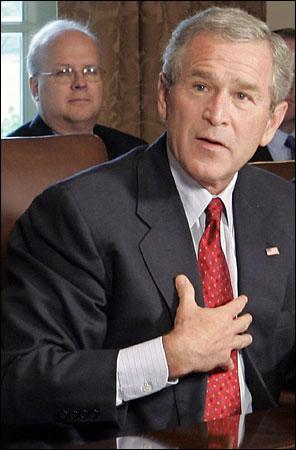
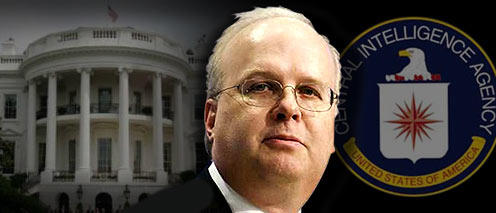
THE ENEMIES OF KARL ROVE WILL FAIL

The President of America, George W. Bush seems to be saying,"You cannot pin this on me." Karl Rove looks on with his chin up behind GWB.

As more facts are being revealed, it is becoming very apparent that all the detractors of Karl Rove will be disappointed and disgraced. Because, as I have already stated in the New York Times, Karl Rove would be exonerated.

The latest update on this case is published below.

Source: Rove Got CIA Agent ID From Media

By JOHN SOLOMON, Associated Press Writer 3 minutes ago

WASHINGTON - Chief presidential adviser Karl Rove testified to a grand jury that he talked with two journalists before they divulged the identity of an undercover
CIA'
officer, but that he originally learned about the operative from the news media and not government sources, according to a person briefed on the testimony.

The person, who works in the legal profession and spoke only on condition of anonymity, because of grand jury secrecy, told The Associated Press that Rove testified last year that he remembers specifically being told by columnist Robert Novak that Valerie Plame, the wife of a harsh Iraq'
war critic, worked for the CIA.
Rove testified that Novak originally called him the Tuesday before Plame's identity was revealed in July 2003 to discuss another story.

The conversation eventually turned to Plame's husband, Joseph Wilson, a former ambassador who was strongly criticizing the Bush administration's use of faulty intelligence to justify the war in Iraq, the person said.

Rove testified that Novak told him he planned to report in a weekend column that Plame had worked for the CIA, and the circumstances on how her husband traveled to Africa to check bogus claims that Iraq was trying to buy nuclear materials in Niger, according to the source.

Novak's column, citing two Bush administration officials, appeared six days later, touching off a political firestorm and leading to a federal criminal investigation into who leaked Plame's undercover identity. That probe has ensnared presidential aides and reporters in a two-year legal battle.

Rove told the grand jury that by the time Novak had called him, he believes he had similar information about Wilson's wife from another member of the news media but he could not recall which reporter had told him about it first, the person said.
When Novak inquired about Wilson's wife working for the CIA, Rove indicated he had heard something like that, according to the source's recounting of the grand jury testimony.

Rove told the grand jury that three days later, he had a phone conversation with Time magazine reporter Matt Cooper and — in an effort to discredit some of Wilson's allegations — informally told Cooper that he believed Wilson's wife worked for the CIA, though he never used her name, the source said.

An e-mail Cooper recently provided the grand jury shows Cooper reported to his magazine bosses that Rove had described Wilson's wife in a confidential conversation as someone who "apparently works" at the CIA.

Robert Luskin, Rove's attorney, said Thursday his client truthfully testified to the grand jury and expected to be exonerated.
"Karl provided all pertinent information to prosecutors a long time ago," Luskin said. "And prosecutors confirmed when he testified most recently in October 2004 that he is not a target of the investigation."

In an interview on CNN earlier Thursday before the latest revelation, Wilson kept up his criticism of the White House, saying Rove's conduct was an "outrageous abuse of power ... certainly worthy of frog-marching out of the White House."

But at the same time, Wilson acknowledged his wife was no longer in an undercover job at the time Novak's column first identified her. "My wife was not a clandestine officer the day that Bob Novak blew her identity," he said.

Federal law prohibits government officials from divulging the identity of an undercover intelligence officer. But in order to bring charges, prosecutors must prove the official knew the officer was covert and nonetheless knowingly outed his or her identity.

Rove's conversations with Novak and Cooper took place just days after Wilson suggested in a New York Times opinion piece that some of the intelligence related to Iraq's nuclear weapons program was twisted to exaggerate the Iraqi threat.

Democrats continued this week to sharpen their attacks, accusing Rove of compromising a CIA operative's identity just to discredit the political criticism of her husband.

On Thursday, Senate Democratic leader Harry Reid of Nevada pressed for legislation to strip Rove of his clearance for classified information, which he said President Bush should have done already. Instead, Reid said, the Bush administration has attacked its critics: "This is what is known as a cover-up. This is an abuse of power."
Senate Majority Leader Bill Frist, R-Tenn., said Democrats were resorting to "partisan war chants."


Across the Capitol, Rep. Rush Holt
, D-N.J., introduced legislation for an investigation that would compel senior administration officials to turn over records relating to the Plame disclosure.

Pressed to explain its statements of two years ago that Rove wasn't involved in the leak, the White House refused to do so this week.
"If I were to get into discussing this, I would be getting into discussing an investigation that continues and could be prejudging the outcome of the investigation," White House spokesman Scott McClellan said.

Wednesday, July 13, 2005

ROVE ON THE STOVE


I have to rush to publish this report on the controversial case of the leakage of State Secret that seems to have taken the attention of America away from the emergency security situation caused by the catastrophic Terrorist Suicide Bomb Attacks in London last Thursday. And I am afraid that while the American government is being harassed and embarrassed by the American press over these scandals, the terrorists could attack America from behind like they did to the British whilst Tony Blair was busy basking in the euphoria of the choice of London as the host of the 2012 Summer Olympic Games and tap-dancing to Live 8 Charity concerts for the benefit of Africa and also hosting the G-8 Summit in Gleneagles, Scotland.

The case is an interruption of the daily attention of the White House, Pentagon and the CIA on the emergencies of the war in Iraq and Afghanistan (Online - 1 hour ago. US says 17 militants killed in Afghanistan .) The American Press and the Democrats should not distract the attention of George W. Bush from the matter of life and death in the war against terrorism. Because, these scandals raising dust in America could affect the morale of the American soldiers and allies in Iraq and Afghanistan. Because as our Lord Jesus Christ said, "A HOUSE DIVIDED AGAINST ITSELF CANNOT STAND". Americans should put their house in order before the cookie crumbles. The American press should not continue to snarl at Karl Rove like hungry dogs on the streets of Harlem.

For the information of those who don't know the details of the case, below is a very good report on it from the Economist.

Karl Rove in the spotlight

Jul 13th 2005.
From The Economist Global Agenda.

A scandal over the unmasking of a CIA agent, which has already seen a journalist sent to jail for refusing to reveal her source, is now putting an uncomfortable spotlight on Karl Rove, George Bush’s chief political adviser.

UNTIL recently, the questions were largely theoretical. How far does a journalist’s right to protect sources extend? Is the free flow of information more important than a criminal investigation? Judith Miller, a New York Times reporter, has gone to jail for refusing to say who revealed the identity of a CIA agent to her, unleashing a flurry of articles on these academic questions. But new revelations in the scandal have dragged the spotlight from journalists back to politicians—and in particular to Karl Rove, President George Bush’s chief political guru.

In 2002, before the Iraq war, a former American ambassador named Joseph Wilson went to Niger for the CIA to investigate claims that Saddam Hussein had sought uranium there. Mr Wilson found the claims bogus, but Mr Bush included the Niger story in his case for going to war nonetheless. In 2003, after the war, Mr Wilson wrote an article denouncing Mr Bush’s use of the Niger claim. Soon after, a conservative columnist, Robert Novak, revealed that Mr Wilson’s wife, Valerie Plame, was a covert CIA operative.

Journalism and the law in America Jul 7th 2005
A hard choice about press freedom Jul 7th 2005
Journalistic privilege and the Valerie Plame case Aug 19th 2004
Journalistic privilege Aug 19th 2004
Karl Rove and American politics Feb 20th 2003
Karl Rove's fading ambition Jun 20th 2002
United States

Robert Novak's article was published on July 14th 2003.
Newsweek reveals what Karl Rove told Matthew Cooper.
The Intelligence Identities Protection Act protects the identities of CIA and other undercover intelligence officers. Wikipedia has profiles of Karl Rove and Valerie Plame. Reporters Without Borders reports on the case.


Mr Novak’s column was meant to undercut Mr Wilson’s article—he suggested that Mr Wilson’s Niger trip came at his wife’s behest, making it seem as though he would not otherwise have been sent. But in disclosing Ms Plame’s identity, Mr Novak moved the story away from Niger and uranium and towards the “senior administration officials” who had told him she was a spy. Someone, perhaps one of Mr Novak's sources, also told several other journalists including Ms Miller. The result was that Ms Plame’s covert career was ruined, seemingly in revenge against her husband. It looked, at the very least, to be an unusually shameful bit of political street-fighting. And, potentially, a crime. The Intelligence Identities Protection Act of 1982 makes it illegal to expose undercover spooks. This put pressure on Mr Bush to appoint a special prosecutor, Patrick Fitzgerald, to find the leaker. Early speculation centred on several senior aides, but attention was before long firmly focused on Mr Rove. This delighted Democrats, who would dearly love to bring him down. The man known to Mr Bush as “boy genius” and “turd blossom” was the architect of the president’s two election wins, and is credited by friends and enemies alike with almost supernatural powers of political cunning.

How, then, did the trickle of rumours surrounding Mr Rove become a stream and then a flood over the course of the investigation? In his efforts to get to the bottom of things, Mr Fitzgerald sought to have the New York Times’s Ms Miller and Matthew Cooper, a reporter for Time magazine, jailed for refusing to co-operate. Time caved in, releasing Mr Cooper’s e-mails and notes related to the story. These confirmed that he had spoken to Mr Rove. And on Sunday, Newsweek magazine published excerpts from one such e-mail from Mr Cooper to his editor, confirming that Mr Rove told the reporter that Ms Plame worked for “the agency”.

The case is, however, not yet closed, at least not the criminal case. To have violated the Intelligence Identities Protection Act, the exposer must be authorised to see classified information, must know the officer is undercover, and must know that the CIA is taking “affirmative measures” to conceal the operative’s identity. Mr Cooper’s e-mail does not make clear Mr Rove knew Ms Plame was undercover. However, the CIA did seem to be taking “affirmative measures” to protect her identity. The agency has since kept her from publishing an article clarifying what happened, saying it could damage their work.

Regardless of whether anyone will be convicted of a crime, the affair has the potential to become highly embarrassing for the Bush administration. Mr Novak spoke of not one but two senior administration sources who told him about Ms Plame. Mr Bush has said he will fire anyone found to have broken the law and take the “appropriate action” against anyone who leaked classified information.

With a fight looming over the Supreme Court, Democrats may see the Plame affair as an opportunity to weaken Mr Bush at a crucial moment

This week saw the first signs that the administration is getting rattled. In tense press conferences on Monday and Tuesday, Scott McClellan, Mr Bush’s press secretary, faced a fusillade of hostile questions from the usually compliant press pool. He responded repeatedly that the administration would not comment on an ongoing investigation. This struck the journalists as particularly fishy, given that Mr McClellan had previously been happy to discuss the affair, categorically denying the involvement of Mr Rove and other advisers. Mr Bush too intoned the “ongoing investigation” mantra when asked about the affair on Wednesday. Why the sudden silence?

The administration may be hoping that the less said now, the greater the chance that it will all blow over. If Mr Rove is cleared of breaking the law by the special prosecutor—perhaps because it cannot be proved that he knew Ms Plame was undercover—Mr Bush may decide that the “appropriate action” for leaking secret information is no action at all. The administration that prides itself on its discipline would then look weaselly. But that might seem a better option than admitting any wrongdoing with a sacking, especially of someone as important as Mr Rove. After all, no further investigation into the matter is likely to come from a Republican-dominated Congress. And the battle over Mr Bush’s first Supreme Court nominee—following the retirement of Sandra Day O’Connor—has far more long-term political importance than Mr Rove’s fate, and may divert Democrats’ attention from the Plame affair.

But on the other hand, with the Supreme Court fight looming, Democrats may see the Plame affair as an opportunity to weaken Mr Bush at a crucial moment. And the press corps is in high dudgeon, feeling misled by the administration while one of their own is in a prison jumpsuit for protecting an administration source. They are unlikely to let the matter drop.

MY FINAL WORD OF ADVICE TO THE AMERICAN PRESS:
Please, stop these dangerous distractions of the White House and let the President of America concentrate on the prosecution of the "do or die" war against terrorism.

TERRORIST ATTACKS ON AMERICA BEFORE OSAMA BIN LINDEN WAS BORN : 1920 -2005.


This is a record of all terrorist attacks in America and in countries with American interests and on American Embassies and citizens abroad.
Osama bin Laden did not create the demons of terrorism. He is only one of the most diabolical and destructive of them all. The devil is the author of Terrorism in his capacity as the Son of Perdition and the father of chaos.

It is very important to clarify these issues for the benefit of those who are ignorant and naive and have been jumping to erroneous conclusions.

Terrorist Attacks
(within the United States or against Americans abroad)

1920:
septa. 16, New York City: TNT bomb planted in unattended horse-drawn wagon exploded on Wall Street opposite House of
Morgan, killing 35 people and injuring hundreds more. Bolshevist or anarchist terrorists believed responsible, but crime never solved.

1975
Jan. 24, New York City: bomb set off in historic Fraunces Tavern killed 4 and injured more than 50 people. Puerto Rican nationalist group (FALN) claimed responsibility, and police tied 13 other bombings to the group.

1979
Nov. 4, Tehran, Iran: Iranian radical students seized the U.S. embassy, taking 66 hostages. Fourteen were later released. The remaining 52 were freed after 444 days on the day of President Reagan's inauguration.

1982–1991
Lebanon: Thirty US and other Western hostages kidnapped in Lebanon by Hezbollah. Some were killed, some died in captivity, and some were eventually released. Terry Anderson was held for 2,454 days.

1983
April 18, Beirut, Lebanon: U.S. embassy destroyed in suicide car-bomb attack; 63 dead, including 17 Americans. The Islamic Jihad claimed responsibility.
Oct. 23, Beirut, Lebanon: Shiite suicide bombers exploded truck near U.S. military barracks at Beirut airport, killing 241 Marines. Minutes later a second bomb killed 58 French paratroopers in their barracks in West Beirut.
Dec. 12, Kuwait City, Kuwait Shiite truck bombers attacked the U.S. embassy and other targets, killing 5 and injuring 80.

1984
Sept. 20, east Beirut, Lebanon: truck bomb exploded outside the U.S. embassy annex, killing 24, including 2 U.S. military.
Dec. 3, Beirut, Lebanon: Kuwait Airways Flight 221, from Kuwait to Pakistan, hijacked and diverted to Tehran. Two Americans killed.

1985
April 12, Madrid, Spain: Bombing at restaurant frequented by U.S. soldiers, killed 18 Spaniards and injured 82.
June 14, Beirut, Lebanon: TWA flight 847 en route from Athens to Rome hijacked to Beirut by Hezbollah terrorists and held for 17 days. A U.S. Navy diver executed.
Oct. 7, Mediterranean Sea: gunmen attack Italian cruise ship, Achille Lauro. One U.S. tourist killed. Hijacking linked to Libya.
Dec. 18, Rome, Italy, and Vienna, Austria: airports in Rome and Vienna were bombed, killing 20 people, 5 of whom were Americans. Bombing linked to Libya.

1986
April 2, Athens, Greece:A bomb exploded aboard TWA flight 840 en route from Rome to Athens, killing 4 Americans and injuring 9.
April 5, West Berlin, Germany: Libyans bombed a disco frequented by U.S. servicemen, killing 2 and injuring hundreds.

1988
Dec. 21, Lockerbie, Scotland: N.Y.-bound Pan-Am Boeing 747 exploded in flight from a terrorist bomb and crashed into Scottish village, killing all 259 aboard and 11 on the ground. Passengers included 35 Syracuse University students and many U.S. military personnel. Libya formally admitted responsibility 15 years later (Aug. 2003) and offered $2.7 billion compensation to victims' families.

1993
Feb. 26, New York City: bomb exploded in basement garage of
World Trade Center, killing 6 and injuring at least 1,040 others. In 1995, militant Islamist Sheik Omar Abdel Rahman and 9 others were convicted of conspiracy charges, and in 1998, Ramzi Yousef, believed to have been the mastermind, was convicted of the bombing. Al-Qaeda involvement is suspected.

1995
April 19, Oklahoma City: car bomb exploded outside federal office building, collapsing wall and floors. 168 people were killed, including 19 children and 1 person who died in rescue effort. Over 220 buildings sustained damage.
Timothy McVeigh and Terry Nichols later convicted in the antigovernment plot to avenge the Branch Davidian standoff in Waco, Tex., exactly two years earlier. (See Miscellaneous Disasters.)
Nov. 13, Riyadh, Saudi Arabia: car bomb exploded at U.S. military headquarters, killing five U.S. military servicemen.

1996
June 25, Dhahran, Saudi Arabia: truck bomb exploded outside Khobar Towers military complex, killing 19 American servicemen and injuring hundreds of others. Thirteen Saudis and a Lebanese, all alleged members of Islamic militant group
Hezbollah, were indicted on charges relating to the attack in June 2001.

1998
Aug. 7, Nairobi, Kenya, and Dar es Salaam, Tanzania: truck bombs exploded almost simultaneously near 2 U.S. embassies, killing 224 (213 in Kenya and 11 in Tanzania) and injuring about 4,500. Four men connected with al-Qaeda two of whom had received training at
al-Qaeda camps inside Afghanistan, were convicted of the killings in May 2001 and later sentenced to life in prison. A federal grand jury had indicted 22 men in connection with the attacks, including Saudi dissident Osama bin Laden, who remained at large.

2000
Oct. 12, Aden, Yemen: U.S. Navy destroyer USS Cole heavily damaged when a small boat loaded with explosives blew up alongside it. Seventeen sailors killed. Linked to
Osama bin Laden, or members of al-Qaeda terrorist network.

2001
Sept. 11, New York City, Arlington, Va., and Shanksville, Pa.: hijackers crashed two commercial jets into twin towers of World Trade Center; two more hijacked jets were crashed into the Pentagon and a field in rural Pa. Total dead and missing numbered 2,9921: 2,749 in New York City, 184 at the Pentagon, 40 in Pa., and 19 hijackers. Islamic al-Qaeda terrorist group blamed. (See September 11, 2001: Timeline of Terrorism.)

2002
June 14, Karachi, Pakistan: bomb exploded outside American consulate in Karachi, Pakistan, killing 12. Linked to al-Qaeda.

2003
May 12, Riyadh, Saudi Arabia: suicide bombers killed 34, including eight Americans, at housing compounds for Westerners. Al-Qaeda suspected.

2004
May 29–31, Riyadh, Saudi Arabia: terrorists attack the offices of a Saudi oil company in Khobar, Saudi Arabia, take foreign oil workers hostage in a nearby residential compound, leaving 22 people dead including one American.
June 11–19, Riyadh, Saudi Arabia: terrorists kidnap and execute Paul Johnson Jr., an American, in Riyadh, Saudi Arabia.
Dec. 6, Jiddah, Saudi Arabia: terrorists storm the U.S. consulate killing 5 before being subdued by Saudi security who killed five of the militants.

See also U.S.-Designated Foreign Terrorist Organizations; Suspected al-Qaeda Terrorist Acts.

On Oct. 29, 2003, New York officials reduced the number of people killed at the World Trade Center in the September 11, 2001, terrorist attacks on the United States by 40 names. The list of casualties dropped to 2,752 from 2,792 for a variety of reasons: some people initially reported missing have been found, there were duplicate names, there was no proof that a person was at the World Trade Center that day, and because of fraud. On January 2004, the number was reduced by 3 more to 2,749.

Information Please® Database, © 2005 Pearson Education, Inc. All rights reserved.


Related content from HighBeam Research on:Terrorist Attacks
MUCH IS BEING DONE TO PROTECT AGRICULTURE FROM A TERRORIST ATTACK, BUT IMPORTANT CHALLENGES REMAIN (Government Accounting Office Report)

Coordinated terrorist attacks: implications for local responders. (The FBI Law Enforcement Bulletin)

Security Council condemns 'barbaric' London terrorist attacks, unanimously adopting resolution 1611 (2005). (M2 Presswire)
World leaders at G-8 summit unite to condemn wave of terrorist attacks in London
(AP Worldstream)
Analysis: Today's terrorist attacks in Iran (Weekend Edition - Sunday (NPR))

COALITION FOILS 8 ATTACKS IN IRAQ, DETAINS 116 TERRORISTS (Regulatory Intelligence Data)

EU officials call for rapid response to terrorist attacks in London (AP Worldstream)
3RD LD: Explosions rip through London, Blair condemns as terrorist attacks+ (Kyodo World News Service)

BOMB BLASTS ROCK LONDON ; Many feared dead in bus explosions Tube targeted in terrorist attacks (Evening Telegraph)

U.S. stock markets shrug off terrorist attacks in London. (The Baltimore Sun (Baltimore, Maryland) (via Knight-Ridder/Tribune Business News))