Posts Subscribe comment Comments

Earn Money With Your Website

Tuesday, August 30, 2005

WHEN AMERICA SUFFERS, WHAT DO WE DO?


Aug. 30, 2005 - WHEN AMERICA SUFFERS, WHAT DO WE DO?


OUR URGENT APPEAL TO THE REST OF THE WORLD TO COME TO THE AID OF AMERICA IN THE CATASTROPHE OF HURRICANE KATRINA.
Tuesday,August 30,2005.

When the catastrophic Tsunamis struck Indonesia, Sri Lanka and the other countries in the Indian Ocean, America rushed to the rescue of the terrified victims and till date there are more American emergency Aid workers still doing their best to save precious lives and rehabilitate the homeless thousands. But when natural disasters happen in America, the rest of the world will not rush to help Americans in distress. Why? Because, they believe Americans can take care of themselves? But, this is wrong and inhuman. Because, death is no respecter of persons. Scores of people have already died from the collateral damages of Hurricane Katrina and the worst hit millions of people are in Louisiana, Mississippi and Alabama with the death toll of over 55 precious souls who are innocent of the wrath of the earth. Now what are we going to do to help America in her hours of need? Yes, America is now in dire need of our help. And giving helping hands is not always giving money. Words of comfort go a long way to help those who are hurting and languishing as millions of those who have lost their loved ones, homes and very valuable properties worth billions of dollars in Louisiana, Mississippi and Alabama. The thousands of refugees are in the shelter in the New Orleans' Superdome stadium, where power was lost early Monday power supplies, water supplies and businesses have been wrecked. The trauma is nerve-wrecking and millions of people in New Orleans are harrowing in sorrow now. And their sorrow will linger till tomorrow.

Only God who understands why these terrible disasters happen can comfort us. But, what can we do to prevent there earthquakes, tsunamis, tornados, hurricanes, volcanic eruptions and other catastrophic disasters on planet earth? Are our scientific exploits not enough to develop the means to avert these disasters? Have we failed to develop the technologies to build safer homes that can withstand these disasters? Have we ignored the knowledge that God has already given us to overcome all these natural and unnatural disasters of the wrath of the earth and allow ourselves to be living in fear and trembling in the shadow of death?

We have many questions, but very few answers. How can we continue to survive on this planet earth, the only home we have in the whole universe? Or are we going to look for another planet that will be safer for human habitation? Where is such a planet? Only God has the answers to all the questions of the fears of humans on earth.

Of course, the precious lives lost can never be replaced. Human Life is priceless. Who will comfort the bereaved. America is going through trials and tribulations and yet America has the time to come to our rescue in Niger, the Sudan, Ethiopia and other parts of Africa and the rest of the world where there are emergencies. Now let us come to bear with Americans in this their moments of pains and tears of great loss as they suffer the ravages of this catastrophic Hurricane called Katrina.

Hurricane Katrina's wrath still being felt as death toll rises to 55

Holbrook Mohr
Canadian Press
Tuesday, August 30, 2005

Adeline Perkins carries her dog, Princess, as Lynell Batiste carries Timmy while Kewanda Batiste and Ulysses Batiste swim through the flood waters from their Lacombe, La. home. (AP Photo/Mari Darr~Welch)

GULFPORT, Miss. (AP) - U.S. Gulf Coast residents staggered from the body-blow inflicted by hurricane Katrina, with more than a million people without power, lowlands swamped and at least 55 dead - a number likely to increase as rescuers reach the hardest-hit areas.

Boats rescued people clinging to rooftops, hundreds of trees were uprooted and sailboats were flung about like toys after Katrina crashed ashore Monday in what could become the most expensive storm in U.S. history.

The U.S. federal government began rushing baby formula, communications equipment, generators, water and ice into hard-hit areas of Louisiana, Mississippi and Alabama, along with doctors, nurses and first-aid supplies.

The U.S. Defense Department sent experts to help with search-rescue operations.

The death toll jumped late Monday when Harrison County emergency operations center spokesman Jim Pollard said an estimated 50 people had died in the county, with some 30 dead at a beach-side apartment complex in Biloxi.

"This is our tsunami," Biloxi Mayor A.J. Holloway told the Biloxi Sun Herald.

Mississippi Emergency Management Agency officials refused to confirm the deaths. Three other people were killed by falling trees elsewhere in Mississippi and two died in a traffic accident in Alabama, authorities said.

The total does not include 11 deaths in South Florida when a much-weaker Katrina first made landfall last week.

Katrina knocked out power to more than a million people from Louisiana to the lorida Panhandle - the westernmost areas of the southern state - and authorities said it could be two months before electricity is restored to everyone. Ten major hospitals in New Orleans were running on emergency backup power.


"It will be unsafe to return to the coastal area for several days," Mississippi Gov. Haley Barbour told evacuees Monday. "Be patient. Don't be in a hurry to go back."

According to preliminary assessments by AIR Worldwide Corp., a risk modeling firm, the property and casualty insurance industry faces as much as $26 billion US in claims from Katrina.


That would make Katrina more expensive than the previous record-setting storm, Hurricane Andrew, which caused some US$21 billion in insured losses in 1992 to property in Florida and along the Gulf Coast.


Mississippi's economy was also dealt a blow that could run into the millions, as the storm shuttered the flashy casinos that dot its coast. The gambling houses are built on barges anchored just off the beach, and Barbour said emergency officials had received reports of water reaching the third floors of some casinos.


After striking the Gulf Coast as a Category 4 hurricane, Katrina was later downgraded to a tropical storm as it passed through eastern Mississippi, moving north at nearly 35 km/h. Winds early Tuesday were still nearly 100 km/h.


At New Orleans' Superdome stadium, where power was lost early Monday, some 9,000 refugees spent a second night in the dark bleachers. With the air conditioning off, the carpets were soggy, the bricks were slick with humidity and anxiety was rising.

"Everybody wants to go see their house. We want to know what's happened to us. It's hot, it's miserable and, on top of that, you're worried about your house," said Rosetta Junne, 37.


Associated Press reporters Mary Foster, Allen G. Breed, Brett Martel, Adam Nossiter and Jay Reeves contributed to this report.

-

On the Net:

National Hurricane Center:

Http://www.nhc.noaa.gov

Monday, August 29, 2005

FBI RAIDS THE HOME OF THE VICE PRESIDENT OF NIGERIA


ALHAJI ATIKU ABUBAKAR.

ALJAZEERA just reported that the FBI raided the American residence of the Vice President of Nigeria, Alhaji Atiku Abubakar.

Alhaji Atiku Abubakar wants to be the next President of Nigeria in 2007. And his only rival is the former head of state, the retired General Ibrahim Gbadamosi Babaginda who is also a northerner. Both men have enough ill-gotten wealth to rig the Presidential Election in 2007. They are leaders of the corrupt Nigerian oligarchy. Alhaji Abubakar has many wives and concubines. And he is also very queer.

The full report is published below.
FBI raids Nigeria official's US home

Sunday 28 August 2005, 22:24 Makka Time, 19:24 GMT
Vice President Atiku Abubakar's home was searched (file)

The FBI has raided the Maryland residence of the Nigerian vice president as part of an investigation into whether a US legislator made or approved payments to officials in West Africa, a US newspaper reported.

A US State Department spokeswoman confirmed the search had taken place but would not make further comment.

"All inquiries regarding the search of the United States' residence of Nigerian Vice President Atiku Abubakar should be directed to the Department of Justice," she said.

The Justice Department declined to comment.

The raid, which took place on 3 August but has just come to light, was in connection with an investigation into William Jefferson, a Democratic legislator from New Orleans, the city's Times-Picayune newspaper said on Saturday.

Diplomatic channels

The Nigerian vice president was not available for comment on Sunday, but a Nigerian presidential spokeswoman said: "The presidency has been notified of the incident and is using diplomatic channels to find out the reason and the findings surrounding the incident."

A source familiar with the investigation said subpoenas showed federal agents were looking for records indicating whether Jefferson paid, offered to pay or authorised payments to Nigerian or Ghanaian government officials, The Times-Picayune said.

Agents were seeking documents related to Jefferson's dealings with Abubakar and the vice president of Ghana, Aliu Mahama. Jefferson returned from a five-day visit to Ghana in mid-July, about three weeks before the FBI raided his homes, according to the newspaper.

The subpoenas focused partly on a telecommunications deal Jefferson was trying to engineer in Nigeria over the past year, according to documents and those familiar with details of the investigation.

Kentucky company

According to The Times-Picayune, sources familiar with the telecommunications deal said Jefferson was attempting to smooth the way for iGate Corp., a small Kentucky company, to offer its high-speed broadband technology to Nigeria's fast-growing telecommunications market.

Jefferson's spokeswoman, Melanie Roussell, said the eight-term legislator would continue to decline comment on the federal investigation. He has only said he is cooperating with federal investigators, according to the newspaper.

Jefferson's attorney, Mike Fawer, has said he thinks the FBI had been conducting a sting operation against his client.

Abubakar and his wife, Jennifer, a doctoral student at American University in Washington, were said to be in Nigeria.


Reuters

Saturday, August 27, 2005

"YAHOO-YAHOO" NIGERIAN INTERNET SCAM SPAM: DON'T BE A VICTIM!


The greed for American dollars and to get rich quick have driven thousands of young Nigerians to the Internet for the sole purpose of Scams. What they now now "Yahoo-Yahoo" in Nigeria. They use chicanery and flattery to deceive, hoodwink and to rob their foreign victims in America, Europe, Australia, Asia and the Middle East.
No day passes without seeing these Scam spam in the e-mails. But, mostly in free e-mail accounts. The best advice is to delete them immediately you see unsolicited spam mail.


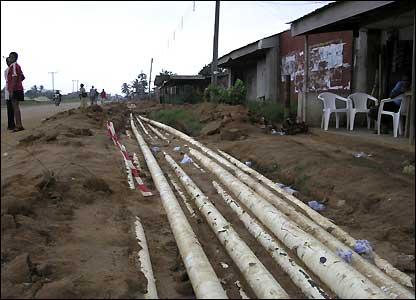
Oil pipelines run through Nigerian villages. But, the billions of dollars Nigeria makes daily from crude oil and gas exports have been stolen by corrupt Nigerian rulers and their contractors. Over 200 billion pounds have been stolen by the corrupt civilian and military rulers in Nigeria since Shell struck oil in the country in 1956. The greediness and wickedness of these Nigerian tyrants and power brokers of the Nigerian oligarchy have left the majority of the over 135 million Nigerians in ruins as the picture above shows.

We have to republish this very important report already widely circulated, because most people have the problem of recollection of such things that we know could make a lot of difference. The sooner the people in America and Europe in particular stop responding to Internet Scam spam mail, the better for us all in Nigeria and others in the world. Because, we want the rest of the world to stop calling Nigerians bad names and to stop painting Nigeria bad in the global village. If you ignore these Internet scammers, they will stop. If you really want them to stop, then you should stop responding to them. It takes two to tango. How can you claim millions of dollars you have not won? When did you play the lottery? How did they get your e-mail address when you did not subscribe to them. Heh! Dollars don't grow on trees. Let us agree now to stop the notorious Nigerian 419 Internet Scammers! All right?

Internet Spam and Scam in Nigeria
Business Archive
August 7, 2005 BY DULUE MBACHU.
LAGOS, Nigeria.

Day in, day out, a strapping, amiable 24-year-old who calls himself Kele B. heads to an Internet cafe, hunkers down at a computer and casts his net upon the cyber-waters. Blithely oblivious to signs on the walls and desks warning of the penalties for Internet fraud, he has sent out tens of thousands of e-mails telling recipients they have won about $6.4 million in a bogus British government "Internet lottery." "Congratulation! You Are Our Lucky Winner!" it says. So far, Kele said, he has had only one response. But he claims it paid off handsomely. An American took the bait, he said, and coughed up "fees" and "taxes" of more than $5,000, never to hear from Kele again. Festac Town, a district of Lagos where the scammers ply their schemes, has become notorious for "419 scams," named for the section of the Nigerian penal code that outlaws them.

YOU DON'T KNOW ME ...
No one knows for sure which of these dodges, if any, were invented in Nigeria, but fraudsters in the West African nation have made them so famous that they are often called ''419 scams,'' after the clause in the Nigerian penal code that outlaws them. A look at some of the more common ones: ''You don't know me, but I used to be married to a corrupt dictator ...''

Nigerians are most commonly associated with scams featuring purported officials or relatives of dead dictators seeking help in getting millions of dollars out of Nigeria or any other African country. Victims are promised a large chunk of the money supposedly stolen from the state treasury, but first must put up money to show their trustworthiness. Variations include proposals for lucrative oil, construction or procurement contracts purported to have been issued by some state-owned company or government department, all with the object of extracting payments from the victim in the form of taxes, fees and bribes to facilitate the promised payoff. ''You're in luck ...'' Targets are told they have come into some sudden fortune and need only complete a few bureaucratic procedures to claim it. These procedures turn out to be costly. Victims are often churches and charities, which are told that a millionaire somewhere has willed them a fortune. ''You Are Our Lucky Winner!'' Millions of e-mails are sent telling recipients they have won millions of dollars (or any hard currency) in an ''official Internet lottery.''

The ''winners'' are given the name of an agent who will handle upfront ''taxes'' and other levies. ''Your price is right ...'' A scammer contacts someone selling a car or other valuable over the Internet and accepts the advertised price. The scammer sends the seller a check for perhaps twice the amount, then claims to have made a mistake and asks the seller to wire the difference to a bank account in Nigeria or elsewhere. The seller obliges, then discovers the check sent to him is fake. AP
In Festac Town, an entire community of scammers overnights on the Internet. By day they flaunt their smart clothes and cars and hang around the Internet cafes, trading stories about successful cons and near misses, and hatching new plots. Festac Town is where communication specialists operating underground sell foreign telephone lines over which a scammer can purport to be calling from any city in the world. Here lurk master forgers and purveyors of such software as "e-mail extractors," which can harvest e-mail addresses by the million. Now, however, a 3-year-old crackdown is yielding results, Nigerian authorities say. Nuhu Ribadu, head of the Economic and Financial Crimes Commission, said cash and assets worth more than $700 million were recovered from suspects between May 2003 and June 2004. More than 500 suspects have been arrested, more than 100 cases are before the courts, and 500 others are under investigation, he said.

The agency won its first big court victory in May when Mike Amadi was sentenced to 16 years in prison for setting up a Web site that offered juicy but phoney procurement contracts. Amadi cheekily posed as Ribadu himself and used the agency's name. He was caught by an undercover agent posing as an Italian businessman. This month, the biggest international scam of all -- though not one involving the Internet -- ended in court convictions. Amaka Anajemba was sentenced to 2-1/2 years in prison and ordered to return $25.5 million of the $242 million she helped to steal from a Brazilian bank. The trial of four co-defendants is to start in September. Why Nigeria? There are many theories. The nation of 130 million, Africa's most populous, is well-educated, and English, the lingua franca of the scam industry, is the official language. Nigeria bursts with talent, from former NBA star Hakeem Olajuwon to Nobel literature laureate Wole Soyinka. But with World Bank studies showing a quarter of urban college graduates are unemployed, crime offers tempting career opportunities -- in drug dealing, immigrant-trafficking, oil-smuggling and Internet fraud. The scammers thrived during oil-rich Nigeria's 15 years of brutal and corrupt military rule, and democracy was restored only six years ago. "We reached a point when law enforcement and regulatory agencies seemed nonexistent. But the stance of the present administration has started changing that," said Ribadu, the scam-busting chief.

President Olusegun Obasanjo is winning U.S. praise for his crackdown. Interpol, the FBI and other Western law enforcement agencies have stepped in to help, said police spokesman Emmanuel Ighodalo, and Nigerian police have received equipment and Western training in combating Internet crime and money-laundering.

Experts say Nigerian scams continue to flood e-mail systems, though many are being blocked by spam filters that get smarter and more aggressive. America Online spokesman Nicholas Graham said Nigerian messages lack the telltale signs of other spam -- such as embedded Web links -- but its filters are able to be alert to suspect mail coming from a specific range of Internet addresses.

Also, the scams have a limited shelf life. In the con that Internet users are probably most familiar with, the e-mailer poses as a corrupt official looking for help in smuggling a fortune to a foreign bank account. E-mail or fax recipients are told that if they provide their banking and personal details and deposit certain sums of money, they'll get a cut of the loot. But there are other scams, like the fake lotteries. Kele B., who won't give his surname, said he couldn't find work after finishing high school in 2000 in the southeastern city of Owerri, so he drifted with some friends to Lagos, where he tried his hand at boxing. Then he discovered the Web. Now he spends his mornings in Internet cafes on secondhand computers with aged screens, waiting "to see if my trap caught something," he said. Elekwa, a chubby-faced 28-year-old who also keeps his surname to himself, shows up in Festac Town driving a Lexus and telling how he was jobless for two years despite having a diploma in computer science. His break came four years ago when the chief of a fraud gang saw him solve what seemed like "a complex computer problem" at a business center in the southeastern city of Umuahia and lured him to Lagos. He won't talk about his scams, only about their fruits: "Now I have three cars, I have two houses and I'm not looking for a job anymore."

Friday, August 26, 2005

PIPE DREAMS IN NIGERIA


I am publishing more recent reports on the critical situation in the Niger Delta of Nigeria where 40% of the oil and gas supplies for America comes from. But, the US Government has been ignoring the emergency in the Niger Delta of Nigeria. And I will keep on reminding the whole world of the emergency untill I see the positive responses from the United Nations, the United States of America and Europe, because they are the largest beneficiaries of the resources in the Niger Delta and I sincerely appeal to you all to address this emergency, because when the crisis shall erupt, the gas suppy to the US will be drastically reduced and you will pay more than you have ever paid for gas since the war in Iraq started. A word is enough for the wise. But, I will not stop reporting the news from Nigeria to the rest of the world, whether good or bad.

PIPE DREAMS: Conflicts, Participation, Transparency.
July 29, 2005

Second installation of the WAGP series:
Oil and Gas Conflicts in the Western Delta Gas for the West African Gas Pipeline will be sourced from the Escravos area in the Western Niger Delta. It must be noted that this is a grossly neglected and environmentally degraded area of the Niger Delta.

It is an area noted for violent state repression and conflicts arising from competition for control of land and resources between the Nigerian government, oil and gas companies and the communities. The proponents of WAGP have clearly kept a blind eye to the concerns of the communities in these gas fields. Without an attempt to resolve these issues, there is the grave danger that WAGP will exacerbate the crisis in the area, which will lead to further disruptions in gas supply, while worsening the insecurity and impoverishment in the area. The foundation is being laid for the continuation and exportation of conflict from the Niger Delta to local communities that would be negatively affected by the WAGP project in Lagos and Ogun states ,Southwest Nigeria. This is already being encouraged by the failure of the government and WAPco to consult with community people, respond to their concerns and pay adequate compensation for lands acquired from families and communities in these areas.

A LOT OF HOT AIR
Gas flaring is a major issue locally and internationally. The oil corporations operating in the Niger Delta have continued to toe the cheap option of dealing with associated gas through gas flaring.

The WAGP has been falsely promoted as a gas flare reduction project even though its sponsors have not demonstrated commitment to addressing the problem in Nigeria. In May 2005, Shell which is a project sponsor unilaterally announced that it would not be meeting its commitment to eliminate routine flaring of associated gas from its oil fields in 2008. Neither has Chevron given adequate guarantees that the WAGP would contribute to gas flare reduction by ensuring that only associated gas from its Escravos oil fields would be supplied to the pipeline.

FALSE CLAIMS
Chevron and the World Bank have been presenting the WAGP to the world as a clean energy project which should qualify for credit under the Clean Development Mechanism (CDM) of the Kyoto Protocol of the United Nations Framework Convention on Climate Change. The request for CDM credit is predicated on the claim that the pipeline project would contribute to the reduction of gas flaring in the Niger Delta of Nigeria. However, Chevron, the World Bank and the Nigerian government have failed to show and demonstrate how the flaring of associated gas (which is the gas being flared in the Niger Delta) will be reduced as a result of WAGP. We state our objection to the move by sponsors of the WAGP including the World Bank and the Nigerian government to sell this lie. In as much as the pipeline project will be utilizing gas from new gas fields and would not significantly impact on the volume of gas being flared in the region it is unethical to claim that this is a CDM project and to reap carbon credits and make profits based on questionable assumptions.It should be noted that Chevron was part of the Global Climate Coalition, an oil industry lobby group which fiercely opposed the Kyoto Protocol. Now, they want to benefit - because it is profitable! We demand a commitment that 100 per cent associated (currently flared) gas be used for the WAGP until associated gas from existing and future fields is exhausted. Moreover, WAGP sponsors and other major transnational oil companies operating in Nigeria should be compelled by law to provide a written commitment and concrete plan to end all associated gas flaring by 2008, both for operations associated with WAGP and other oil developments in the country. In addition, Nigerian national legislation should ensure that all new oil development in the country be accompanies by gas gathering infrastructure, and utilisation programs for power generation within Nigeria.Need for TransparencyAs a condition for commencement of the pipelines operation, project sponsors and the Nigerian government should disclose to the Nigerian people:
1.The WAGP Treaty and Annexed International Project Agreement,
2.All gas purchase or off-take agreements between WAPCO and the consumers / governments of Ghana, Togo and the Republic of Benin,
3.The contract between Ghana and Nigeria for the latter to provide a loan to the former for its equity stake in the pipeline, and
4.The economic and financial assessments of WAGP.
Oil pollution and environmental degradation are major issues in Nigeria's oil industry - and were the subject of a forum held this weekend by the National Assembly.

Oil pollution and environmental degradation are major issues in Nigeria's oil industry - and were the subject of a forum held this weekend by the National Assembly.

The goal was to find long-term solutions to the problem. Local communities in the oil-rich Niger Delta region have consistently accused the government and oil companies of colluding to plunder their oil resources and impoverishing them through unmitigated pollution and environmental degradation. The two-day session closely examined the nature of oil pollution and environmental degradation in the oil-rich Niger Delta region.

Gamaliel Onosode is a leading financial and public affairs analyst who's also known for his extensive research on environmental problems in the Niger Delta. He listed the problems caused by the crisis. "The problem is serious in more than one way. First, pollution has affected the ecosystem generally. You can see the forest and mangrove swamps, those areas have been wiped out. Two, it has affected water quality. My home is a good example. You sink a bore-hole and you readily see evidence of seepage into the water supply. Thirdly, it has affected air quality."

Thursday, August 25, 2005

NIGERIA COMES TO THE RESCUE OF NIGER


Picture: African refugees on the move.

It is good news to see that Nigeria is going to help Niger.
Well, they are actually neighbours and have a common river, the Niger from which they draw their source of power supply and the river Niger provides drinking water and other things of which the most common is fishing.

The only difference are their different languages. Niger is French speaking, because it was a French colony whilst Nigeria was a British colony and English is the official language of Nigeria. They are what I will call unidentical twins.

When Nigeria Rallies for Niger Republic

Daily Trust (Abuja)
OPINION
August 24, 2005
Posted to the web August 24, 2005.

By Salisu Na'inna Dambatta
The establishment and actual inauguration of a highly visible and active National Committee on Famine Relief for the Republic of Niger by President Olusegun Obasanjo and his directive that each member of the Federal Executive Council should donate N20, 000 to the Famine Relief Fund is both a diplomatic masterstroke and a genuine move of coming to the aid of a friendly and brotherly nation and its populace.
The resultant food scarcity and its devastating impact are visible on the frail bodies of malnourished children, emaciated adults and the remains of thousands of livestock. It is manifested in a massive social dislocation and agony among the estimated 3.6 million people caught in its painful web.

Reports from parts of Niger Republic, especially the densely populated Sahe1ian southern part that shares border with Nigeria, and the central areas in the inhospitable Sahara desert, indicate that nearly 800,000 children are especially vulnerable, even as hundreds of them have already died of starvation. More are in danger of dying from starvation, hence the need for Nigeria to rally for them, to assist them and contribute in saving those that could be rescued by a small, worthy sacrifice.

Nigeria and Niger Republic are cooperating closely at multi-lateral and bilateral levels. Both countries are in the ECOW AS, the African Union, the Lake Chad Basin Commission, the River Niger Joint Commission, the United Nations Organisation, the Organization of Islamic Countries (OIC), the Non-Aligned Movement and a dozen other regional and global organizations.

In fact, Niger Republic has cooperated and consequently developed a unique understanding with Nigeria over the utilization of the waters of River Niger by foregoing an option to dam it upstream, which would have eroded the opportunity for Nigeria to develop the strategic hydropower generating stations at Kainji and Jebba. A percentage of the power generated from the hydropower station at Kainji is sold at a preferential rate to Niger Republic.

Majority of the people of Niger Republic have strong ties and affinities with the peoples in Nigerian states sharing border with that country.

At least 90.8 per cent of the people of Niger are Hausa, Zabarmawa, Fulani, Kanuri or Shuwa Arabs, just like the people on the Nigerian side of the border in Borno, Yobe, Jigawa, Katsina, Sokoto and Kebbi states. There are countless socio-economic contacts on daily basis, in shared markets and festivities such as Argungu fishing festival, in mosques during marriage, child naming or funeral rites. Herdsmen from both sides of the border often share grazing reserves. Inter-marriages across the border are regarded as normal and very common.

The facts stated in the preceding paragraph and the natural tendency of Nigerians to be their brothers' keepers are some of the reasons for the swift and generous response to aid the famine victims of Niger Republic. In Kano, a private radio station is mobilizing individual donors and it seems to be serving as a collector of donations. The Government of Kebbi State has dispatched 33 trailers laden with rice, millet, sorghum and maize to Niger Republic for those in need. Governor Muhammad Adamu Aliero also sent drugs and medical personnel for the sick in the areas affected by famine. It would be appropriate for the Nigerian Medical Association (NMA) to consider mobilizing volunteers from its ranks to go to Niger Republic and assist. The Nigerian Red Cross, according to its Chairman, Dr. Ibrahim Tahir, has sent a team there. But what are the two main Islamic Aid Groups planning? If Non-Governmental Organizations from Europe and as far off as the United States of America could move into Niger Republic to assist, those in Nigeria are morally bound to also act appropriately.

It is significant that, despite the propensity of the dominant Western media to focus largely on the token doled out to the people of Niger Republic by Western countries and their NGOs, Nigeria has for long provided succour to its neighbour without making much noise or claiming credit, even though doing so would not be improper.

As stated earlier, consumers from Niger Republic attend markets in Nigerian towns and cities, including Lagos, Onitsha and Aba, to purchase foodstuff and other goods. So, when Nigeria officially sold grains to the World Food Programme (WFP) for delivery to Niger a few weeks ago, this writer regarded it as just a complex extension of the daily simple commercial transactions between the citizens of the two countries.

The Nigerien community in Nigeria is one of the largest on earth. Some members of that community have much confidence and trust in our country and have invested heavily in Nigeria, thereby creating employment for Nigerians to the extent that the question of their nationality is no longer an Issue.

So, if people from Niger Republic would sell to and buy from Nigerians or invest their hard-earned money in our country when the going was good for them, it is only proper for Nigeria and Nigerians to come together and assist them in their hour of need. This is one element of a special relationship. One other factor that contributed in making the relationship between Niger Republic and Nigeria so special is that the 1,497 kilometre-Iong borders we share is probably the most peaceful of all our international borders. There is no serious, peace-threatening border dispute between Nigeria and Niger Republic.

It is rare for criminals or bandits, cattle rustlers or invading soldiers from Niger Republic to cross into Nigeria and cause havoc. This cannot be said of some of our neighbours that seem to be spoiling for war with our country over a boundary dispute.

In the final analysis, given the positive role Nigeria plays in Africa and across the world in peace keeping operations, facilitating conciliation between or among disputants and giving leadership among peers, it is only natural for President Olusegun Obasanjo to set up the Masari Committee in the belief that Nigerians would show compassion, solidarity and generousity to the famine victims in Niger Republic.
As stated earlier, the spirit of compassion, giving and solidarity was demonstrated for the Asian tsunami victims, for the Russians when they had a disaster and for countless other causes. It can be repeated for the benefit of our special friends and neighbours.

Indeed, rallying for Niger Republic would be a historic continuation of our good neighbourliness, which was extended to Liberia, Sierra Leone, Sudan and other countries. It is also a practical manifestation of our concern for the welfare of fellow human beings.

Copyright © 2005 Daily Trust. All rights reserved. Distributed by AllAfrica Global Media (allAfrica.com).